
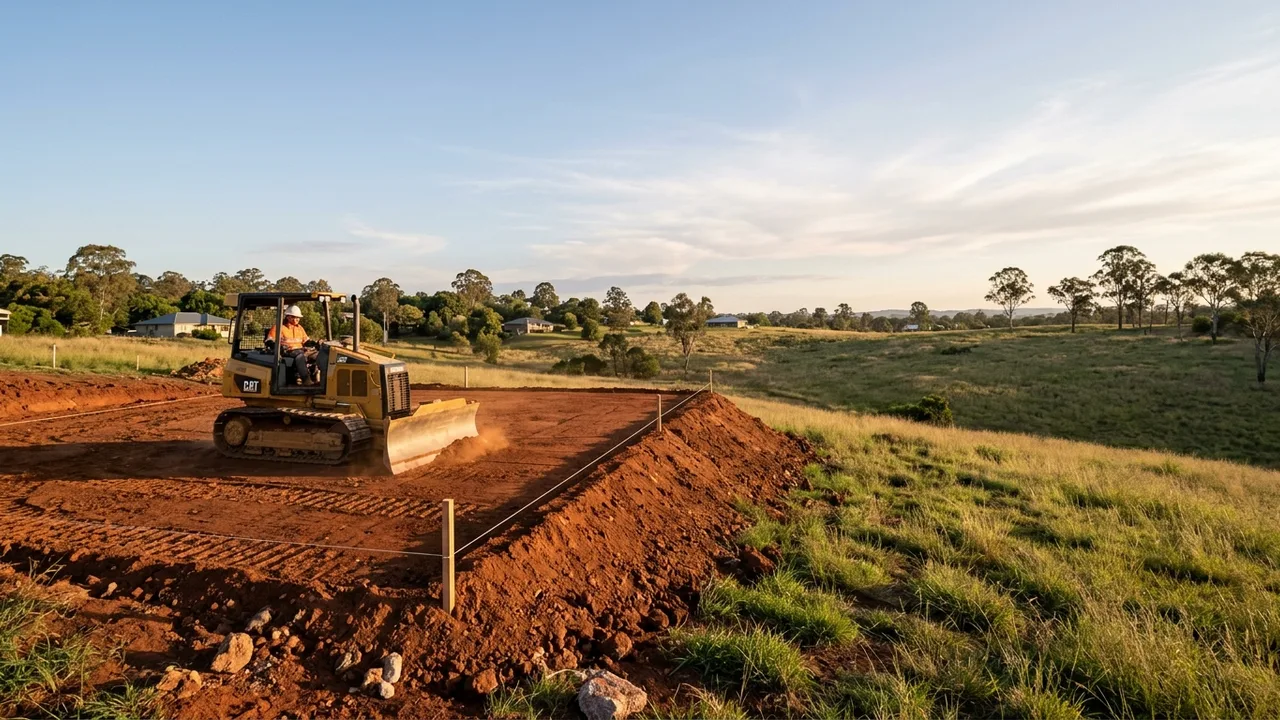
Site Preparation in Toowoomba for House Pads and Sheds
Trees and stumps are holding up your builder. Site preparation in Toowoomba clears the house pad, shed site and driveway to an agreed scope.
Most owners want two things: the house pad, shed site and access cleared to an agreed scope, and the shade trees they love left standing. Both start with walking the block with the contractor before the machine turns up and tying tape on the trees to keep, so nobody has to guess on the day.
Site preparation in Toowoomba: what gets cleared before building
Clearing for a build is narrower than clearing a whole paddock. The aim is a clear footprint for the house, a clear patch for the shed and a usable way in from the road.
Trees and scrub come down first. Stumps follow, because a stump left under a slab or driveway slowly rots and leaves a soft spot that settles. The roots go with it, at least through the area that will carry load.
Where land clearing ends and site preparation begins
Land clearing removes vegetation and stumps from a defined area. Site preparation is the wider run of work before construction, and clearing is its first stage. Once the ground is clear, the builder or engineer decides what comes next, such as stripping topsoil, levelling or compaction (pressing the ground firm so it does not settle).
The clearing needs a working margin beyond the slab line. Formwork crews need room to set boards and stand, and machines need space to turn without chewing up the edge of the pad.
Pricing the house pad, shed and driveway as separate lines lets you see what each part costs and drop one if the budget is tight. Retained trees and their protection zones go on the same plan.
House pads, driveways and sheds compared
The three areas pose different problems. A house pad is the most thorough clear, because anything left in the ground becomes the builder's problem later.
An access route is about reach rather than depth. The contractor looks at what the trucks will cross and how wide a strip needs to be open for deliveries.
A shed is judged by its slab. A slab that takes a vehicle or a heavy machine is as unforgiving of old roots as the house is.
Slopes and soft ground on Darling Downs blocks
A block on the range side of Toowoomba, around suburbs like Mount Lofty, can fall away steeply, while a paddock out on the Downs plain may be flat but hold water.
A steep fall limits where a tracked machine can work safely, while flat ground lets it reach the whole pad. Ground that holds water turns boggy after rain, which may delay work or call for a lighter machine.
A narrow gate, side easement or tight corner can limit access as well. The operator decides safe routes on site, working around the trees you want to keep. Ask the contractor how they have handled blocks like yours.
What drives the cost of site preparation
Price follows machine hours and what leaves the block. A dense regrowth block with many stumps takes far longer than a few big trees on flat ground, and a steep or tight site slows the machine further. Waste handling is its own cost line.
A national guide from iseekplant.com.au, as at October 2026, puts residential land clearing at $40 to $150 per cubic metre. The same source gives mulch disposal at $50 to $120 per load and spoil disposal at $20 to $60 per cubic metre.
These are national figures, not Toowoomba quotes. A written quote for your block sets the real number and names what it covers and what it leaves out.
Check the rules before clearing near Toowoomba
Current property mapping shows whether Queensland vegetation rules apply to your land, and other restrictions can sit on a title. Check the mapping and your council's local laws before any tree comes down. The contractor can help work out what applies, but some approvals or notifications sit with the landholder.
The trees you want to keep matter here too. A mature shade tree or windbreak takes years to replace, so tie tape on it early and leave a protection zone around the trunk and its roots.
Getting your quote started
Say what stands on the house pad now, how large the block is, where the machine would enter and how the ground falls. Name the trees that must stay and how you want the green waste handled.
Type those details into the Request a Clearing Quote form, so the pad, the stumps and the waste can each be priced as their own line.
How it works
-
Walk the block and mark what stays
The contractor looks at the plans and the land, then marks shade and windbreak trees to keep, with room left around trunks and roots.
-
Get the work in writing
The quote sets the work area, stump treatment, waste handling and exclusions, so the cost of carting stumps and timber is written down before any machine arrives.
-
Clear the footprint and access
Trees, scrub and regrowth come out of the marked areas, working around the trees that stay.
-
Remove the stumps
Stumps and major roots are dug out of the slab and driveway areas. How deep the roots must come out under load-bearing ground is settled by the builder or engineer before the slab is set out.
-
Finish the waste plan
Green waste is mulched or carted off, so the builder is not working around brush piles.
-
Hand over the site
The cleared footprint and access track are handed over at the point agreed in the quote, with no stumps or brush piles in the way.
Scope in detail
- House footprint The builder sets out the plan on cleared ground, so the cleared area follows the slab or stump line with a working margin.
- Shed site Cleared to the slab footprint plus room for the slab crew, with the edge set where the formwork boards will sit.
- Access route A low power line or a tight gate can decide whether a tipper truck or only a small machine can reach the pad.
- Stump removal Old stumps and major roots are dug out of the agreed areas, and your builder or engineer sets any further treatment under slabs and driveways.
- Green waste Mulching on site usually costs less than carting, but it leaves a mulch layer the builder may need stripped off the pad.
Site preparation for building options
- House pads Priced as its own line, because the builder needs this area clear first and it usually takes the most machine time.
- Driveways and access Cleared as a strip sized for a concrete truck, with low limbs and overhanging branches cut back along the route.
- Sheds Stumps come out only where the slab and its working edge sit, so a shed on open ground may need little more than scrub removal.
Site preparation for building across Toowoomba
Frequently Asked Questions
How much does site preparation cost in Toowoomba?
How do I clear land for building on a Toowoomba block?
What is the difference between land clearing and site prep in Toowoomba?
Get it priced
Overgrown block holding up your build? Tell us about the land and get the clearing moving.
Share the details and we will help you take the next step with confidence.