
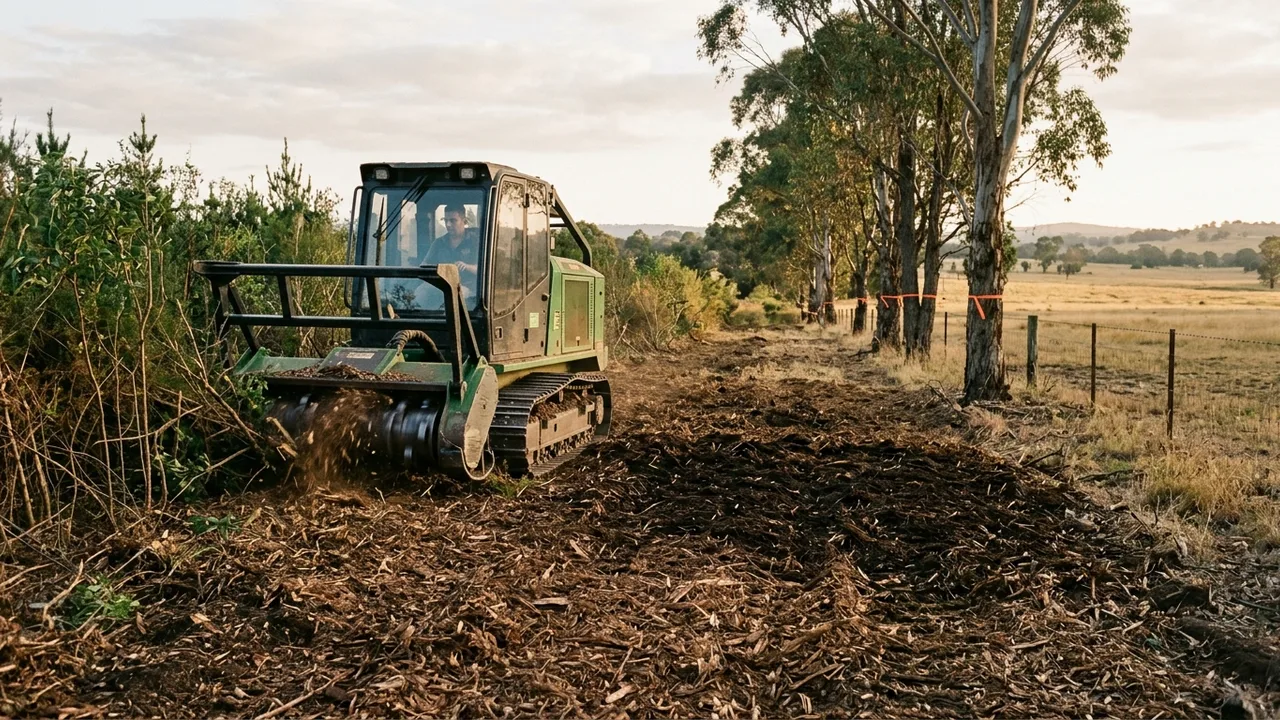
Land Clearing Mulching in Toowoomba
Lantana or regrowth taking over a paddock or fence line? For land clearing mulching in Toowoomba, the machine grinds it down where it stands and leaves usable ground, with no burn piles to wait on.
Mulching suits overgrown paddocks, fence lines and scrub near sheds, but it will not give you a building surface. It leaves roots and organic material behind, so a house pad needs a separate stage.
Land clearing mulching in Toowoomba: how the job works
Forestry mulching is a way of clearing land by shredding it. A tracked machine with a spinning drum or head grinds brush, scrub and small trees into chips right where they grow. There is no felling crew, no truck loading and no heap left waiting for the right conditions to burn.
It fits best when the problem is density rather than size. A back paddock gone to lantana, a block full of regrowth after an old clearing, or a strip of scrub between the house and the boundary are all good candidates. Large mature trees are a different job, and a contractor will tell you plainly when a stand needs conventional felling instead.
Mulching lantana and regrowth instead of burning
Burning a lantana heap is slow, smoky and often limited by weather and local conditions. Mulching skips that step. The stems are ground into small pieces that settle on the soil and start to break down.
Dense weeds like lantana often come back after one pass, so the contractor should talk through follow-up, such as a treatment on the stumps or a later pass on fresh shoots.
The chips are not a mess to be cleared. Left on site, they cover bare ground, hold moisture and keep dust down while the area settles.
Mulching near Toowoomba slopes and soft ground
A tracked machine spreads its weight and can work some sloping ground that would bog a wheeled one, but the block still decides what is possible. On a steep block near the range edge, the operator works across the fall rather than straight up it, and a damp gully choked with lantana may have to wait for dry weather. Flat Darling Downs paddocks with heavy ground can turn soft after rain, so the same machine may work one week and not the next.
The slope, any damp gullies and the narrowest gate the machine must fit through change a quote more than block size does.
Mulching also leaves roots in the ground, which helps hold a slope together.
What mulch does for weeds, erosion and fire fuel
Left in place, a layer of chips shades the soil and slows the weeds that would otherwise race back into bare ground. It also cushions rain, so water soaks in rather than running off, which cuts soil erosion on a slope.
On fire, mulching removes standing fuel. Dense scrub that once ran right up to a shed becomes a low layer of chips instead of upright, dry stems. A thick bed of chips is not fireproof, so a contractor may suggest keeping it thinner or clear right beside buildings.
Clearing rules across the Darling Downs
Queensland has vegetation rules, and they apply to mulching just as they do to bulldozing. Your right to clear depends on how your land is mapped and what is growing on it.
One point from state guidance: areas mapped as Category X on freehold, Indigenous and leasehold land count as exempt clearing work. Land mapped differently follows different rules, and other restrictions can still sit over a property.
A contractor should work from current property mapping before the machine starts, and you should hear what permissions, if any, your land needs. Raise the rules early, because a block you cannot clear is better discovered before the quote than after the first pass.
What drives the price of mulching
Density and access move the price most. Dense lantana, thick stems, a steep or soft block and a narrow gate each add more machine time than raw area does.
Area still counts, because more ground means more hours, and a long trip for the machine adds to the bill. Stump treatment, hauling mulch away and protecting retained trees each belong in the quote as their own lines.
A written quote sets out the agreed scope and exclusions, so you can see what the price covers and what would cost extra.
Questions worth putting to a mulching contractor
Mulch depth near buildings is worth raising first. A good contractor will say where chips can lie thick and where they should be raked back or removed, and why.
Trees you want to keep need marking before work begins, with a protection zone around each trunk and its roots. The mulch plan, whether spread, stockpiled or removed, should be written down.
Mistakes to avoid: accepting a price with no stated work area, assuming lantana is gone after one pass, and starting before the clearing rules for your land are settled.
Lantana or regrowth getting away from you? Give the rough area, how thick the growth runs and how wide the gate is, then request a mulching quote for your Toowoomba block.
How it works
-
Walk the land
The contractor looks at the scrub, the slope, the soft spots and how a machine gets in, then marks the trees you want kept.
-
Agree the written quote
The work area, stump treatment, mulch plan and exclusions go in writing before any machine arrives.
-
Mulch the brush
The machine works through the marked area, grinding lantana, regrowth and small trees into chips as it goes.
-
Leave the block ready
The mulch is dealt with as agreed and the cleared area is inspected. Excavation and ground preparation for the next use are a separate job, scoped by your contractor or builder.
Scope in detail
- Lantana thickets The machine knocks the thicket down in one pass, so nobody is hand-cutting dense stems. Follow-up on regrowth is quoted separately.
- Regrowth and small trees Young scrub and thin trunks are shredded where they stand, so you can see the ground, the fall and any trees worth keeping.
- Overgrown paddocks and lifestyle blocks A cleared paddock is easier to graze, slash or subdivide into usable ground.
- Scrub beside sheds and fences Cutting dense growth back from buildings lowers the fire fuel nearby.
Forestry mulching options
- Selective clearing around retained trees Undergrowth comes out while marked shade and windbreak trees stay standing, with protection zones around trunks.
- Firebreak and fuel reduction Scrub and heavy grass are cut back from sheds, fences and the house to open up a clear buffer.
- House pad and access clearing Surface growth is cleared from the building footprint and driveway line, ready for the separate stump, root and earthworks stage before the builder starts.
Forestry mulching across Toowoomba
Frequently Asked Questions
How long does mulching take on a Toowoomba block?
What is forestry mulching and how does it clear a block?
What equipment does mulching a Toowoomba block need?
Get it priced
Overgrown block holding up your build? Tell us about the land and get the clearing moving.
Share the details and we will help you take the next step with confidence.