
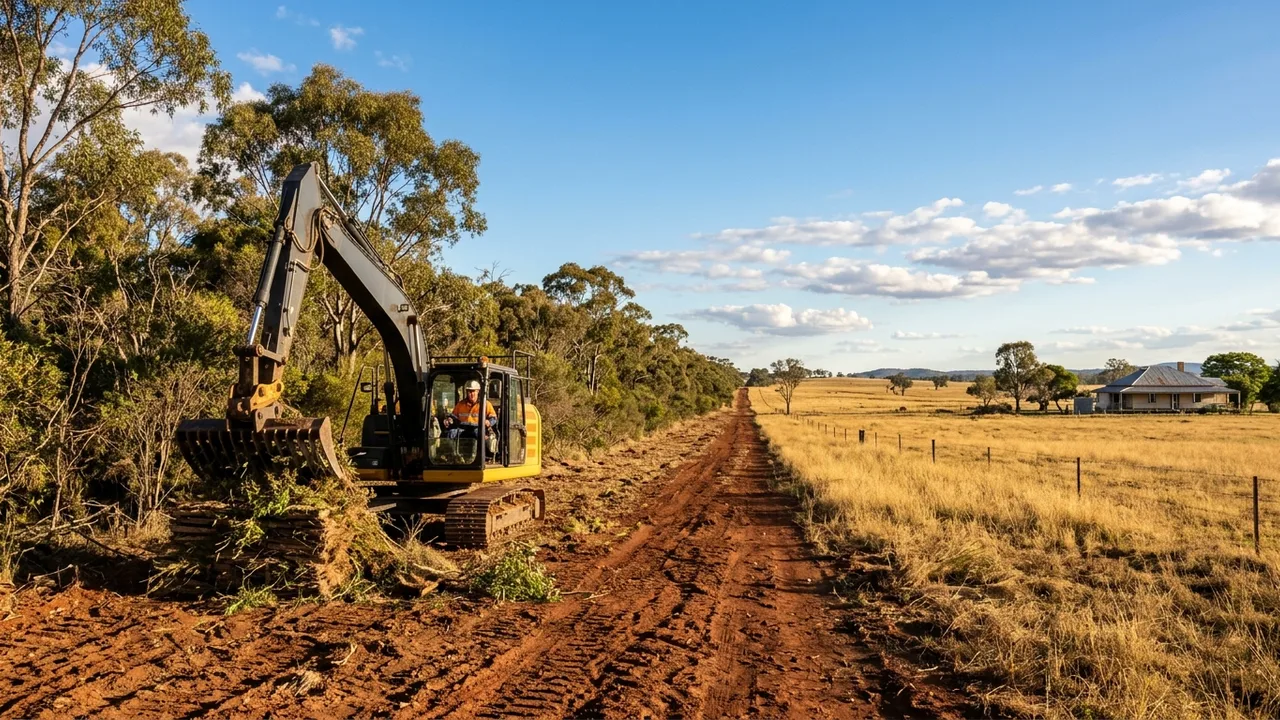
Farm Land Clearing in Toowoomba
Farm land clearing in Toowoomba gets lantana, regrowth and old stumps off the paddocks you want back, while the shade trees stay standing. You get the price in writing first.
A back paddock gone to scrub, a fence line swallowed by saplings and a strip of dry grass too close to the shed are the jobs this work suits. Only the areas you agree on get cleared, and the rest stays as it is. Whether the mulch stays on the paddock or is carted off gets decided before any machine starts.
Farm land clearing in Toowoomba: paddocks, fence lines and firebreaks
A rural clearing job is rarely the whole property. Usually it is one overgrown paddock, a run of fence, or a belt around the buildings.
The goal shapes the plan. A fence line gets a cleared strip beside the wire. A firebreak cuts the fuel between grass and your sheds. A paddock going back to pasture or crops needs more care at the end, because pulled stumps leave holes that must be filled and settled before the first cultivation. That belongs in your timeline.
The machine depends on the growth. Light regrowth and lantana often go to a mulcher or slasher. Thicker timber and big stumps call for a dozer or an excavator with a grab. Once stumps are too big for a mulcher to grind down in sensible time, or the roots must come out for cropping, the dozer takes over.
Clearing near Toowoomba on the Darling Downs: slopes and soft ground
Country near Toowoomba changes quickly. Ground along the range edge is steeper, which limits what a machine can do safely, while flatter Downs paddocks tend to hold water and turn boggy after rain. Slope and soil can differ from one paddock to the next, so each block needs its own look.
Access differs too. A steep gate track can stop a truck carrying a machine, while flat paddocks usually allow a straight approach. Wet ground and a narrow gateway both add machine time, so they show up directly in the quote.
Tracked machines spread their weight on soft ground, and steep pitches may need a different approach or season. Someone who has worked similar Darling Downs jobs knows when to hold off after rain instead of cutting up the paddock.
Acreage on the fringe, such as Hodgson Vale, Cotswold Hills, Cranley and Glenvale, suits this work. Rural properties across the wider Darling Downs are welcome to enquire too.
Do you need approval to clear paddock regrowth near Toowoomba?
Sometimes you do, and it depends on the land and the vegetation. Queensland has vegetation clearing rules, and some work is exempt while other work needs a permission first. Those rules decide what applies to your land, and your local council's rules sit on top of the state's.
Firebreaks have their own exemption. To protect buildings, a necessary firebreak is exempt when the cleared strip is no wider than 20 m or 1.5 times the height of the tallest neighbouring tree, taking whichever allowance is bigger. A wider cut may need approval.
Land under a development approval condition, a covenant, an offset or a declared area may not qualify for an exemption. If part of the paddock needs approval, get that sorted before the machine arrives so the cleared area stays inside what is allowed.
What drives the cost of paddock clearing?
The cost follows the size of the area, how thick the growth is and how many stumps are in the way. Access and slope matter too, because slow or awkward ground means more machine time.
Green waste is the other big item. Mulching on site is usually cheaper than carting timber away, and mulch can be useful to keep on the paddock. Stump treatment adds cost but cuts the chance of resprouting.
Per-stump pricing usually suits a paddock with a few big old stumps, while per-area pricing suits dense regrowth with hundreds of small ones, so it pays to know which the quote uses.
Keeping the shade trees and fence lines you want
You can have the scrub gone and the good trees kept. The trick is marking them first, so the operator is not guessing between a mature gum and a thicket of regrowth.
Protection zones around trunks and roots keep machinery back from vulnerable areas. Soil pressure and torn roots can harm a retained tree long after the job. Fence lines need a similar plan, with the working strip agreed so existing posts and wire are not dragged out.
How it works
-
Walk the boundaries
The contractor looks over the paddocks, fence lines and access gates with you and notes slopes, soft ground and anything in the way.
-
Mark what stays
Shade trees, windbreaks and trees along creeks get marked, and protection zones are set around trunks and roots.
-
Written quote
The quote names the areas, the stump treatment, the green waste plan and anything left out.
-
Clear the agreed areas
Machines work through the marked paddocks, fence lines and firebreak strips, mulching or stacking as agreed.
-
Final walk-through
You look over the finished ground and the contractor deals with anything that does not match the quote.
Scope in detail
- Paddock regrowth and lantana Lantana often comes back after clearing, so a mulched paddock usually needs follow-up on the new shoots to keep pasture ahead of it.
- Stump removal and treatment Treating a stump is worth paying for when it stays in the ground and the species resprouts. Pulling is the better choice where the soil will be ploughed or cropped.
- Mulching or removal of green waste A layer of mulch left on the ground holds moisture and slows weeds, while brush left in heaps becomes a fire and pest problem.
- Shade and windbreak trees kept Marked trees stay standing with space left around trunks and roots, so stock keep their shelter through summer heat and cold winds.
Rural and farm land clearing options
- Selective acreage clearing One overgrown corner or paddock of a larger property goes back to open ground, usually with a mulcher or slasher, while marked shade trees stay.
- Fence line clearing A working strip is cut along boundary and paddock fences, often by excavator, so old wire can be repaired or a new run put in.
- Firebreaks Cleared strips cut the fuel between bush or grass and your house, sheds and yards.
- Farm development and agricultural clearing Whole paddocks go back to pasture or cropping ground, usually with stumps pulled rather than ground so the soil can be worked.
Rural and farm land clearing across Toowoomba
Frequently Asked Questions
How long does a farm land clearing project in Toowoomba take from start to finish?
How long does it take to clear an acre of paddock near Toowoomba?
How do I clear land step by step on a Darling Downs property?
Get it priced
Overgrown block holding up your build? Tell us about the land and get the clearing moving.
Share the details and we will help you take the next step with confidence.